
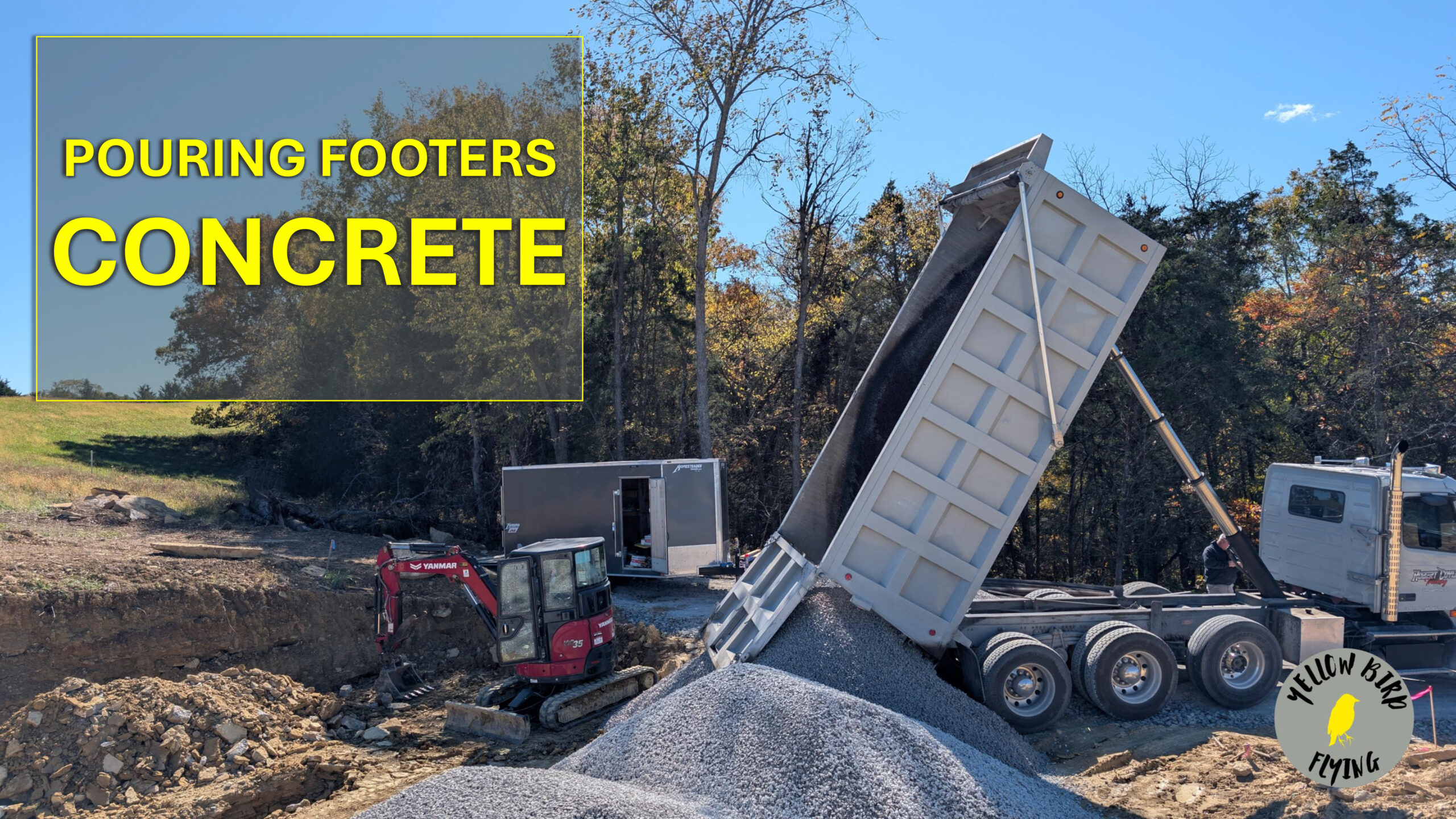
Today, we’re pouring concrete footers for the basement and supporting structure. Jace and his team from Triple J Concrete had a lot of work to do building the wooden forms in allignment with the GPS/laser points that Curd Surveying placed for them.
Our basement will eventually consist of:
-
- Stone: ~250,000 lbs (~113,000 kg)
- Rebar: 30,000 lbs (~14,000 kg)
- Concrete: 1,300,000 lbs (~590,000 kg)
By ‘points,’ I mean the key locations of the house. Since our house isn’t a simple rectangle, what would normally take a few hours, took two days in part to the house design and also a significant storm that showed up just at the wrong time.
Tom Libertiny
To make life more interesting, the day before Dean at Curd Surveying came out to place points, we had a huge rain storm. With Kentucky soil consisting of a lot of clay, rain generally takes one to two weeks to soak into the soil when it’s warm.
Sue and I ended up purchasing a pump and electric generator so we could remove all the water from what was currently a swimming pool. Half a day later, and we were ready for Dean.
Lesson learned: Many vehicles today have an electric inverter that feeds what looks like a regular household outlet. The one we tried to use for the pump was rated at 120 volts AC, 15 amps. More than enough power for the pump.
Except that it wasn’t. That rating was highly overrated and the power kept shutting off every 30 seconds due to a thermal protection circuit breaker.
It gave us the ‘opportunity’ to buy a new gasoline powered generator.
Tom Libertiny


Concrete for the Basement
Next time, Jace and his team from Triple J Concrete pour the walls for our basement.
For even more details, join my free newsletter by clicking HERE.