
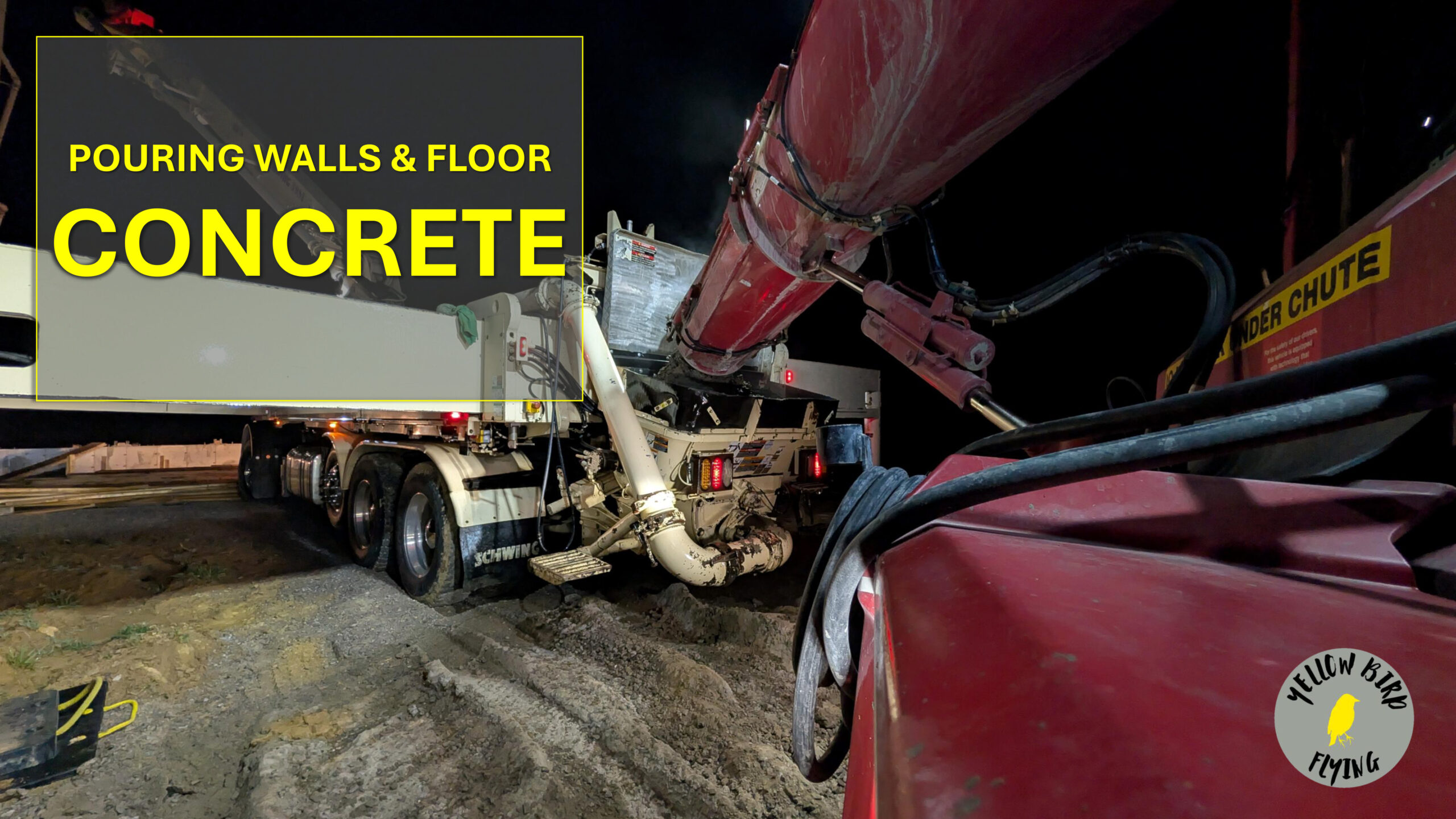
Today, we’re pouring concrete walls and the floor for our basement. Jace, Josh and their team from Triple J Concrete had a lot of work to do building the wooden forms in alignment with the GPS/laser points that Curd Surveying placed for them.
Our basement consists of:
-
- Stone: ~250,000 lbs (~113,000 kg)
- Rebar: 30,000 lbs (~14,000 kg)
- Concrete: 1,300,000 lbs (~590,000 kg)
Weather has been a challenge with temperatures fluctuating from below freezing to 70 degrees Fahrenheit (0 to 20 C). Throw in rain, ice, and snow storms and we ended up having to slow our project down.
Residential meets Commercial Construction
Many folks have commented that Sugar Hill is being designed and constructed more like a commercial building. Here’s the reason why and how:
The foundation preparation, stone, French drain, and heavy-duty footers from our earlier video are all there to support the huge weight of the walls and house structure.
But there’s more to it. All that Kentucky clay can contract and expand by 10% or more between wet and dry weather cycles. That places immense pressure on the basement walls, sometimes in thousands of pounds per square inch (PSI).
And if that wasn’t enough. Being on a hilltop means that winds can blow fast with sustained averages of 70 MPH (~110 KPH) during storms. Sugar Hill was designed for sustained wind speeds of 90 MPH (~145 KPH) with peak winds of 115 KPH (~185 KPH).
That’s why our concrete basement walls are 12 inches thick, have extra rebar, and use three-quarter inch J-bolts to hold down what will eventually be the above-ground steel superstructure to resist the compressive load from the weight of the house and the bending and shear loads from the wind.
There will be some traditional 2×6 (stick) construction with thick Oriented Strand Board (OSB) for additional shear strength, the exterior and core structure of the house is primarily concrete and steel. That’s were the commercial building comparison comes into play.
Water Mitigation
Clay is absolutely wonderful for retaining water. That’s why old swimming pools where coated with it. But that’s the opposite of what we want.
To achieve this, we spent a lot of time designing and building the foundation. Excavating to virgin soil nearly 14 feet under grade. Followed by:
-
- Tons of large crushed stone.
- Extra wide and thick concrete footers with extra rebar.
- More large stone.
- French drains around the interior and exterior perimeter along with a herringbone pattern in the interior of the basement.
- More crushed stone surrounding and over the “burrito wrapped” drain pipe.
- To reduce the heating and cooling loads (HVAC) there’s 2 inches of polystyrene insulation over the stone. There’s also a thermal barrier (break) between the concrete wall and the floor with a different type of insulation.
- Then a thick vinyl water barrier on top of the polystyrene.
- More rebar.
- And then 6 inches of concrete for the floor covered in two coats of sealant.
Our lesson from our earlier home: You can never do too much to protect a home from water damage.
Tom Libertiny
Concrete Strength Verification
Nothing in construction is ever perfect. Sue and I had a question: did one or more of the concrete trucks have the correct 4,000 PSI rated concrete in it?
What happens when two engineers have a questions like that?
Testing!
We hired a company to take core samples from our walls and destructively test them. Good news! They all passed. And we had fun watching the tests.
But the real fun was the equipment that was brought out to locate the re-bar within the concrete wall so the core drill didn’t damage the steel. Imagine a wood stud finder getting married to an Ultrasound and you get an idea about how clearly we were able to see into a 12 inch thick concrete wall!


Steel Superstructure
Next time, we’re building and installing the steel superstructure.
For even more details, join my free newsletter by clicking HERE.